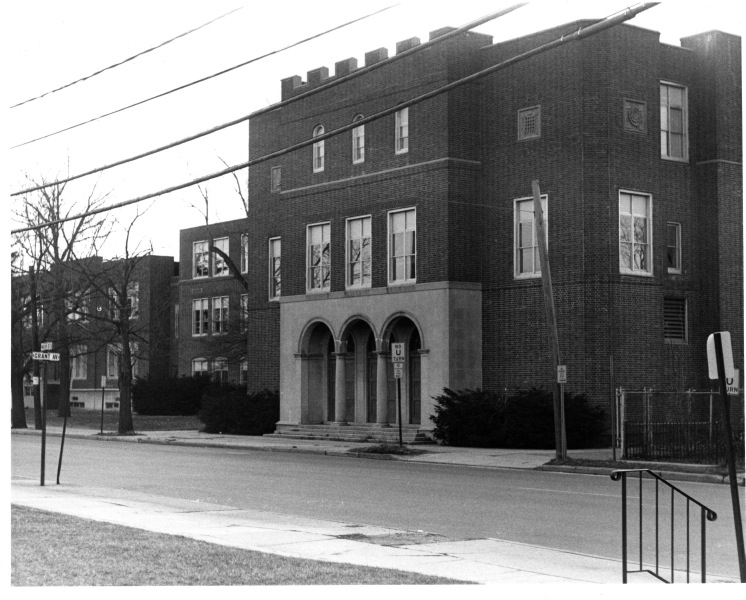
Monday, February 13, 2012

The Cloakroom on Valentine's Day (a poem)

Main Street Elementary School, which I attended in the 1950s. It no longer exists.
I wrote this poem back in the 1970s. It's set in the 1950s. It is, I suspect, based on an invented memory—a memory that, now that I've written about it, seems more real and vivid to me than things that no doubt actually happened in the fourth grade at Main Street Elementary School in Farmingdale, NY, where I grew up. I can't remember now if I've ever published this poem anywhere. It seems appropriate for this week's holiday. I don't know why we used the word "cloakroom," which seems so formal, for the place in the back of the class where we hung our coats and left our galoshes.


The Cloakroom on Valentine’s Day

Remember how,
not long before the time for going home,
we sneaked into the room of coats and shadows
which had beckoned from the back like a cave
since morning
when we turned, whenever we turned,
from our lessons?
Remember how the bell had rung a fire drill
all day, how Teacher told us
to ignore it? And we did,
though it sang and sang like a burn?
(I will not talk.
I will not talk.
A hundred times, a thousand times,
written in our heads.)
How in the noise when Teacher turned
we dipped and darted for the door
like swallows?
Remember being scared to laugh,
afraid that Teacher’s vast shadow
would grow in the doorway,
lit from behind by giggles?
How we shut the door?
And how we played at hiding in the dark
in the cloth of jackets, caps, and scarves?
How with a sudden Hey! we knew
that all the pockets grew with red,
unopened, heart-shaped envelopes and boxes,
and we stood breathless for a second,
hardly daring think the sweets inside?
How (just about to open one)
the door flew wide
and all the light and children,
come for their coats and candy,
filled the secret place and our wide eyes?
But they were blushed too much to notice us?
How we emerged, unchanged,
except for having sensed each other
in the red dark?


Friday, February 10, 2012

HUMILIATION AS ENTERTAINMENT: Why I won't watch the films of Michael Moore

Public humiliation was once a form of punishment. Today it's a form of entertainment.
I received an email today with a link to some of Jay Leno's favorite "Jay-Walking" moments. In these sequences, Leno goes out into the street and asks random folks to answer simple questions, usually about American history or culture. He then airs the silliest answers to those questions. He points to an American flag and asks a young woman how many stars are on it. "I don't know," she says. "It's moving too fast." HAHAHAHAHAHAHA. He asks a different young woman what the "D.C." in "Washington, D.C." stands for. Her answer: "Da capital?" HAHAHAHAHAHAHA.

Like most of America, I laugh at these folks and their ignorance. Then I feel, well, ashamed of myself.

Private humiliation has become public entertainment. We strip people of their dignity and then air the result to the masses. Below is a column I published in the local paper in 2004, when Michael Moore's documentary Fahrenheit 9/11 came out. I agree with Moore's politics; I hate his movies. They represent a sad trend in American culture. It's a trend that's only gotten worse since 2004. (Judge Judy and Dr. Phil, anyone?)


Filmmaker Michael Moore has become famous for subjecting people to public shame.


WHY I WON’T WATCH FAHRENHEIT 9/11
by Ed Weathers
(Originally published in The Roanoke Times in 2004.)
 
I rented Michael Moore’s movie Bowling for Columbine recently. After 15 minutes, I shut it off. Michael Moore’s movies make me squirm—but not for the reasons he intends. I squirm because I belong to that shrinking minority of Americans who don’t like to see people embarrassed in public.
      Michael Moore embarrasses people in public, and I don’t like it. I’m not talking about public figures like Charleton Heston or George Bush or Roger Smith (the General Motors executive Moore eviscerates in Roger and Me). I have no problem with Moore pointing out the stupid, venal, or dangerous policies of actor-shills, presidents and corporate executives. No, I have a problem when Moore embarrasses ordinary citizens—a GM security guard, a bank clerk—in order to wring a little laugh from the audience or make a point that can be just as well made in another way. In the first fifteen minutes of Bowling for Columbine, for example, Moore goes into a bank that offers a free gun to anyone who opens a new account. He opens an account, asks for a gun, and gets it. Granted, this is a telling statement about how easy it is to get a gun in this country—from a bank, no less. But along the way, Moore also seems to be politely mocking the sweet teller who opens the account for him and the perfectly nice bank manager who hands him the gun. After he’s handed the gun, Moore then ambush-interviews the bank manager, peppering him with well-rehearsed questions about the socio-political correlativism of guns and banks. The manager, clearly not prepared to answer such complex questions on the spur of the moment, hems, haws and stumbles. We laugh at him. But which of us could answer such questions cogently without some time to think about them? Moore is trying to make a statement about guns in this country, but I came away from this segment angry, not about stupid American gun laws, but about rude American film directors. I felt sorry for the bank manager. That’s when I turned the movie off.
      Public humiliation has become the most popular sport in America. Virtually every hit “reality” show on television is really a “humiliation” show. People get fired by Donald Trump, thrown off the island on “Survivor,” rejected by The Bachelor, and reduced to screaming fools on “Fear Factor.” We watch and laugh, or gloat, as if we were better than them. And then there’s the hugely successful “American Idol.” Don’t tell me that the viewing public watches “American Idol” to discover talented singers. No, you and I both know that we watch in order to laugh derisively at the poor fools who think they can sing, or dream they can dance, but who in fact have no talent whatsoever—unless you count their willingness to make fools of themselves in public. Okay, I’m pretty sure most of the talentless know they are talentless and just want their two minutes on national tv, but that doesn’t change the fact that Americans watch in order to laugh at them. 

"Queen for a Day": An early example of humiliation-as-entertainment.
      Public humiliation on television goes back almost to the medium’s origins. I still remember a show from the 1950s called “Queen for a Day,” on which women stood before the audience and told the pathetic tales of their lives—drunk husbands, children with polio, accidents in the kitchen—in order to earn the audience’s sympathy. The wife with the most pitiful tale won a refrigerator. I hated that show. It embarrassed me. In more recent years, we’ve had the “I Slept With My Boyfriend’s Dog” school of Jerry Springer television, which simply took the public airing of besmirched underwear to new depths.
      The question now is this: Are Americans still capable of embarrassment? More importantly, are we capable of being embarrassed for someone else? Do we feel sympathy any longer for someone who has been or is being publicly humiliated?
       I of course haven’t seen Michael Moore’s newest film, Fahrenheit 9/11, which just won the top prize at the Cannes Film Festival. I understand from the reviews that the movie blasts the Bush administration for its ties to the Saudis and its failures before and after 9/11. That’s fine with me. A politician’s policies are fair game. Besides, no one can embarrass George Bush more than George Bush embarrasses himself every time he tries to speak off the cuff. (If I need to establish my anti-Bush bona fides here, let me say that I just sent the Kerry campaign a check for 2% of my annual income. If you haven’t done the same, you’ll have no right to complain if Bush wins and gets to appoint Scalia clones as the next three Supreme Court justices, thereby embarrassing the whole country for the next 30 years.)

Paul Wolfowitz doing what seems to count for entertainment in the U.S. today.
      Anyway, I’m sure I’ll agree with the politics of Moore’s new film. But not necessarily with the tactics. There’s one scene in Fahrenheit 9/11 that all the reviewers have mentioned as one of the “best” and “funniest” in the movie—“vintage” Michael Moore. It’s a scene in which Paul Wolfowitz, the deputy defense secretary and chief architect of the Iraq War, is preparing for an interview. Wolfowitz, unaware that his actions will later be seen by millions, sticks a comb into his mouth, wets it with spit, and then runs it through his hair. Apparently we are expected to laugh with gleeful superiority at this picture of the Bush administration’s biggest brain behaving grossly. But I wouldn’t laugh. I would simply be embarrassed for the poor man. After all, who among us doesn’t pick his nose when he thinks no one is watching? Who doesn’t bite his finger nails and spit them secretly into the corner of the motel room when he’s alone? Who doesn’t have some disgusting habit which, if revealed to our friends, would make us want to crawl away and die? I hate Wolfowitz’s unilateralism, his imperialist arrogance, and his conduct of Middle East foreign policy. Only Michael Moore could make me call Paul Wolfowitz “poor man.”
       I don’t plan to see Fahrenheit 9/11. All the “news” in it is old news to anyone who reads and is interested in politics. Mostly, though, I don’t care to see people publicly humiliated. I would think by now that we Americans would have learned what a callous indifference to the humiliation of others can lead to. If you’ve forgotten, just take another look at the photos from Abu Ghraib.

One of a series of Abu Ghraib paintings by Fernando Botera.


Sunday, February 5, 2012

MY BROTHER AND MY POLITICS

My brother George, left, was my life's first companion. That's me on the right. George cheered me on in sports and everything else to the end of his days. He was as generous a soul as I've ever known.
 
This may be in bad taste: I’m about to politicize the memory of my brother George. George died in September, 2008, in the middle of the last presidential election campaign. As we enter another presidential election year, I find myself thinking of him again. This post contains two essays. The first I wrote in 2008; it was published in The Roanoke Times. The second I wrote after George’s funeral; I shared it only with family and with a few friends. As you’ll read, people like George would not fare well in a world run by conservative Republicans. George is a big reason I vote for Democrats.

MY BROTHER AND MY POLITICS
(Written in September, 2008)

My brother George died last week, at the age of 66. Let me tell you about George and why he’s part of the reason I plan to vote for the Democrats in November.
    George never did well in school, though he tried. Oh, how he tried. His virtues were not in his head. They were in his good heart. 

At school and sports, no one ever tried harder than George.

    George did a thousand kindnesses for hundreds of friends. For the last thirty years, he was the full life-support system for a man who was unable, because of mental troubles, to keep himself in home or transportation. This friend used George’s car more than George used it himself. For all practical purposes, he lived in George’s car. George paid for the gas, most of his friend’s food, the cell phone they shared, and all the expenses when they went on trips. You can call what George did for his friend “enabling.” You can call it “bleeding-heart liberalism.” I call it generosity.
    George also gave money to other friends when they needed it, though he didn’t have much himself. Some of these friends took advantage of him, yes, but George never questioned them. He bailed the sons of friends out of jail, but he never judged them.
    Banks, credit card companies, and other businesses, on the other hand, did take advantage of George, who was never good at finance. They offered him unneeded loans. They offered him unnecessary credit cards. They offered him trips to Bermuda for “free.” Sometimes George fell for these offers. At one point our brother Terry had to negotiate with the banks and credit card companies to rescue him from pounding debt. After that, George tore up all his credit cards but one.

George (waving) and me meeting our dad's commuter train. George was forever a devoted son.
     George worked hard all his life and always supported himself. He worked as a machinist at Grumman Aircraft and later Republic Aircraft on Long Island for many years until the aircraft industry weakened and he was laid off. After a brief period on unemployment, which he hated, George became a night-time security officer for his hometown school district on Long Island. Every work night for more than 25 years, right up to last week, he began his rounds at 11 p.m., and he tried to sleep during the day.
     Though strong, George wasn’t blessed with great health. He had a mild form of epilepsy that caused him to have seconds-long seizures, especially when he was nervous or excited. He had serious diabetes and nearly lost his left foot twice. He endured long hospital stays several times in the last three years of his life. The strain of his abnormal sleep schedule didn’t help. He died of a massive infection compounded by his diabetes.
     George never found a woman who appreciated him enough to marry him, and there was some loneliness in that for him. He never measured up to the achievements of his more accomplished siblings, nieces, and nephews. But he was incapable of bitterness or anger, and he never took refuge in drugs or drink or any other vice I ever knew of. His pride in the rest of us was transparently sincere.
     No, George never complained. Instead, he sang in the church choir every Sunday for more than 45 years, joined the local volunteer fire department, and became a stalwart on a number of bowling teams. Along the way, he was the most loyal brother, son, friend, neighbor, and teammate many of us ever had.

George, left, and me in more grown-up years. He was the most loyal brother anyone could ask for.
George is why I vote for Democrats. He’s why I believe in consumer-protection laws, the minimum wage, unemployment compensation, worker-protection legislation, universal health insurance, and guaranteed social security—the kinds of things neoconservative Republicans have always voted against. (Once, there were moderate Republicans who supported such things, but not, apparently, anymore.) The neocons believe in some kind of laissez-faire survival-of-the-fittest ethos that says, “Let the buyer beware” and “Every man for himself” and “Pull yourself up by your own bootstraps.”
     Well, George wasn’t exactly the “fittest.” He was simply the most humble, the most generous, the nicest.
      The Republicans say they are for “national defense.” But shouldn’t “defense” include defending the health, safety, and financial security of people like George, who can’t always defend themselves? Much as I respect some Republicans, it’s Democrats like Barak Obama who have always offered that kind of national defense, as well as the protect-our-shores kind. That’s why I will vote for the Democrats in November.  I will do it for myself and for my brother.
___________

GEORGE’S SENDOFF
(Written immediately after his funeral in September 2008)
George, shown here saluting, was himself saluted by the entire Farmingdale Volunteer Fire Department at his funeral.
Two by two, forty white-gloved firemen in full uniform marched to the front of the viewing room, stood in front of George’s open coffin, and slowly, slowly saluted him. Then, two by two, they lowered their hands,  about-faced right, and marched out of the room. It took 10 minutes for all of them to do this, in absolute silence. Watching them from the soft, high-backed “family chairs” facing the coffin, my brother Terry, sister Joyce, niece Becky and I barely blinked the whole time. It took an honorable forever for the firemen to finish.

The next day, after the funeral service in the church (more talk of Jesus and the resurrection than I remember in 13 years of sermons back in my 1960s Sunday-school days; a beautiful tribute from my niece; a letter read from a pastor far away whom George had coached on the Methodist Youth Fellowship basketball team 40 years ago)—after the church service, the firemen put my brother’s coffin on a fire truck and drove in a procession of five fire trucks to the cemetery eight miles away,  first stopping briefly in front of the fire house for the giant volunteer-summonsing horn to blast twice in valediction, later detouring to pass the house where we grew up, and, at every intersection en route, shutting down main highways. A cortege of ten cars followed the fire engines; my brother Terry and niece were in the first car with me. Entering the cemetery, we all passed beneath a giant American flag strung between the cherry-pickers of two fire engines from neighboring towns, their drivers at attention and saluting. All for George.

At the graveside, the forty firemen once again saluted, then took off their “covers” (hats, for the uninitiated) as the tiny, brisk Korean-American minister gave her final “ashes to ashes” farewell. The minister, new to the church, had said during the funeral service that George had been the choir member who sat nearest her during church services each Sunday, and occasionally he’d whisper to her, as she sat down after a sermon, “Now, that’s the work of a good pastor.” She said how much the encouragement meant to a new pastor. At the graveside, the young funeral director, who knew George and is just beginning to follow in his father’s career steps, wiped away tears. Then the mourners placed yellow roses on the coffin, and we all went home.

But all that wasn’t the most important part of my brother’s going away.

George, left, next to our Aunt Nelle and mother and father. For more than 60 years, George was a faithful member of the Farmingdale Methodist Church and a stalwart in the choir.
At the viewing and the funeral, we had met my brother’s choir friends and his firemen friends and his co-workers, who just about all used the words “sweet guy” to describe him.

But it was the Bowlers and his Chosen Other Friends who reminded me that there is a world of people out there that I almost never think about. It was my brother’s world.

George, it seems, was Shepherd of the Misfits. At the viewing, which went from 2 pm to 9:30 at night on Friday, with a two-hour break for supper, his bowling buddies and the Chosen Others were there all day. They never left. They were the stunted and the stuttering. They were the soft-minded and the myopic.  They were the valiant tryers. There were about 15 of them. Three of them were wall-eyed. Two were barely on the functional end of the autism spectrum, one of whom, Jason, couldn’t keep his hands from flying about when he talked about George, which he did at length. Two of them, Jack and Anthony, are barely five feet tall. They all have bad teeth and talk too loud in viewing rooms and look straight at you as if they had never seen another human being before. They can be unsettling. One young man in his twenties, Joey, is seriously mentally challenged (are there politically correct words for all this? I don’t have time to look for them). Joey is big and soft and is missing all the teeth on the top right side of his mouth. These were the friends my brother had found and chosen for his life. And they had chosen him.

One of my relatives was upset because the Bowlers and the Chosen Others kept taking photos of my brother in his casket. They’d stand in front of him as people do when they have their picture taken with celebrities. They took hundreds and hundreds of photos of my dead brother. He might have been their Lenin.

Every 15 minutes, Joey of the tender mind looked at my brother in the coffin and began to keen. The Chosen Others all wept, all afternoon and into the evening.  My brother, it seems, lived among men with no emotional defenses. They all just kept weeping. After I tried to comfort them and they saw that I liked to talk to them, they came to me with a look in their eyes as if they hoped I might transform myself into George. Joey kept within touching distance of me when he wasn’t kneeling in front of the coffin and talking to George and weeping.

These were men from a Carson McCullers novel. If you haven’t read Carson McCullers, read her.

There were also the daughters of two of the men (who had married those men?), and the daughters wept, too, though they were more in control of themselves than their fathers, except when the one girl wailed at the graveside. She had told me earlier that George had helped her get through some bad times when she was a teenager.  Days later, I found out from my mother that one of the girls had once expressed the hopeful possibility that George was her father.

There was one grown woman among the Others at the viewing: Christine, a charming woman with dyed black hair, a crooked smile, and sweet eyes that weren’t quite parallel. Picasso would have painted her. She was a waitress at Friendly’s restaurant, where George ate many of his meals. (We discovered that he never cooked at home. Never.) Christine and I talked a long time, and she smiled at every memory of George.

The next day, at the cemetery, a different, elegant woman came up to me after the coffin was lowered. “Ed,” she said, “I’m Jackie.” Jackie. A high-school classmate of mine, Jackie had been George’s first love. Her father had been permanently shell-shocked by World War II. For years when she didn’t have her own car, George had driven Jackie to see her father every weekend in the veterans’ mental hospital. In his loyal way, George never stopped loving Jackie, even when she went off to her career as a flight attendant and married and had her own children. It was wonderful to see her. She still has a dimple in her right cheek.

I will never forgive the world for not finding George a wife.

But back to the Bowlers and the Chosen Others. What had George given these people—these short, stammering, misshapen, weeping men, with their potbellies? He was six-foot-two, and strong, and he could speak perfectly well (though he often mumbled, as they do—because they do?), and his teeth and eyes were not crooked, and he never passed judgment on anybody. He knew how to tease them—they loved to tell stories of how he teased them. He knew how to reserve motel rooms when they went to watch professional bowling tournaments in Pennsylvania or for trips to Vermont, where they hung out in their rooms or in the swimming pool and never did anything touristy. He could afford to pay for their motel rooms.

There is a world of people out there that some of us—me, anyway— rarely notice and almost never think about. They don’t vote. They don’t read books or magazines or newspapers. They don’t go to movies much. They bowl and watch professional wrestling. They live in basement apartments or group houses, three beds to a room. (In his will, George left little wall-eyed Jack his easy chair. But Jack told me that he had no place to put it; he lived in one room with three other men.) These men work when they can, at the kind of jobs they can do. They sweep restaurants and work deep behind the baggage-claim at Kennedy Airport. They don’t drive the truck that pulls the wide load on the highway; they drive the flag truck that follows it (and they drive 900 miles to be at George’s funeral). Among people like you and me, they mumble or stay silent. They can’t afford to fix their teeth or their eyes or their tongues. At funerals, they talk loud and weep unashamedly. They were George’s flock.

When I was young, sitting at the dinner table hearing George recount the losses of his day—a failed geometry test, a squabble with another student, getting cut at the j-v basketball tryouts—when I was young (my parents getting more and more upset at George)—when  I was young, I thought I was better than George, and I sometimes let him know it. After this weekend, I don’t think I was good enough to sit at the same table with him.
_____________

So here I politicize my brother George. When you vote this November, remember him and his friends. Vote for the party that keeps people like them in mind. 


Wednesday, January 25, 2012

A Realistic Appraisal of the State of the Union Address

President Obama delivered a pretty good speech.
For much of this election year, my posts will be political.

This is my brief take on the State of the Union Address last night:

President Obama's speech was pretty good, but it had some strange confusions: Does he support fracking or not? How is he going to require states to graduate 100% of their high school students (and how realistic is that plan)? Does the creation of a new Justice Department team to go after those who sold faulty mortgages mean that all the feds' recent negotiations to reach a settlement with those malfeasant banks and mortgage lenders have been ended?

And finally, his central metaphor: Can an entire country ever really act like a SEAL team? And do we really want our democracy to act like a SEAL team? I myself don't think it should. In a good democracy, the members argue and wrestle with each other. They don't all follow the same agenda. They don't have a single "mission" to achieve. The President's analogy is fundamentally flawed.

Still, it was a very good speech.

What Obama did so well was to be positive and optimistic. Some of us have been saying for two years that he (and the Democrats in general) need to emphasize the positive: he's ended the recession, he's added 120,000 jobs a month (on average) for two straight years, he's lowered our dependence on foreign oil, he's increased domestic oil production, he's resurrected the U.S. auto industry, he's helped save the necessary-evil finance industry, he got us out of a stupid and unnecessary war in Iraq, he ended a homophobic military policy (with no ill results whatsoever), and he killed Bin Laden. In the speech, he could have added that the Dow Jones Industrial Average has nearly doubled under his administration, re-energizing the retirement funds of millions of Americans and salvaging the pension funds of thousands of companies and unions. And he could have mentioned that American companies, having reaped huge earnings lately, now have more than a trillion dollars in unspent cash in their coffers—money that they could (and should) be spending to hire new workers.

This chart shows that since Obama's stimulus money entered the country's bloodstream in early 2010, the economy has added millions of jobs.


President Obama also has great oratorical powers: he can milk a pause and squeeze an inflection with the best of them.

This kind of positive, optimistic speech, by the way, is not only good politics, it's also good for the economy, because it makes consumers and businesses more confident in our future—more likely to spend and hire, respectively.

Many of my liberal friends, inspired by the speech, now think Obama will easily beat any of the Republican nominees. I don't think Obama's election is in the bag, however. The key isn't whom the Republicans nominate, it's in how the Democratic candidates for the House and Senate behave. If they get on the Obama bandwagon, support his policies, tout his record, emphasize the positives, and push the effectiveness of their own policies hard, they will win the White House, hold the Senate, and perhaps win back the House. But if they run away from Obama and his policies as they did in 2010—terrified of polls that said the health-care plan and stimulus were unpopular—then both the polls and the election will get away from them again, and they could lose the White House and both houses of Congress. If the economy stumbles, then none of this will matter: he'll lose.


Poor Mitch Daniels had no chance in his rebuttal.
As for the Republican rebuttal, initially I declared that Mitch Daniels' talk was pale and weak (and he certainly looks that way), but then I reconsidered and decided I was being unfair. No one giving the rebuttal—all by himself, in a quiet room, no applause, no chance really to orate, no chance to shake hands, kiss cheeks, or hug Gabby Giffords—can ever come across well compared to a President on a high and mighty (and mighty high) podium giving the State of the Union in front of Congress and the Supreme Court justices. Daniels won't be the Republicans' draft choice for President after this, but it's not his fault.
_____________________


Another good result of the speech telecast: Eric Cantor, the most dangerous man in America, came across as looking like the cynical, rude, snide, smirky, snarky, and snarly hatchet man he is, at least in his public persona. (Who knows? Maybe he's nice to his family.)


I hope Eric Cantor is nicer in private than he is in public. I also hope he returns to the minority in the House in 2013.


Tuesday, January 17, 2012

WHAT TO MAKE OF MITT: A liberal looks for light in a Romney presidency

As a candidate, Romney is a liar and a fraud. But a Romney presidency might not be as terrible as we liberals fear.
As a political candidate, Mitt Romney is a liar and a fraud. That much is clear from his campaign web site, which contains a number of falsehoods about President Obama’s supposed “failures,” and Romney’s innumerable misleading and evasive statements during his campaign for the Republican presidential nomination. (See the end of this blog post if you require proof of Romney’s lies and misrepresentations.)

Nevertheless, despite his public mendacities, equivocations, and deceptions, Mitt Romney has, according to current polls, at least a 50/50 chance of being the next president of the United States. So we liberals need to imagine what such a presidency might mean. Just how bad would it be?

Well, pretty bad. But, in my opinion, probably not horrific in a Dick Cheney/George W. Bush kind of way.

A Romney presidency would probably not be as bad as the two-headed presidency of Cheney-Bush.

I’ve read as much as I can about Mitt Romney, including his campaign web site. Here are links to three good articles about him: from Vanity Fair, from New York magazine, and from The New York Times. Believe it or not, if these articles are to be believed, there are some encouraging things about Mitt Romney. Here are some of them.

  • according to every account, he loves his wife and kids and has been a faithful husband and a caring, involved father
  • his wife has multiple sclerosis and has battled breast cancer
  • once upon a time, his wife gave money to Planned Parenthood and said she favored stem cell research (she is currently silent on these subjects)
  • he has lived in a foreign country and speaks a foreign language (France, French)
  • he has a history of doing significant amounts of weekly volunteer service, even while he was becoming a rich businessman
  • he is worth more than $200 million
  • it is widely reported that, as a businessman, he believes in data, not gut instinct
  • he is reasonably articulate and certifiably smart
  • he’s a Mormon
  • his father was a moderate Republican who challenged the Barry Goldwater conservatives in 1964
  • he almost died in a car accident in France in 1968; one of his passengers did die (the accident was not his fault)
  • he is, by all accounts, frugal to the point of stingy
  • he is, by all accounts, a very hard worker
  • the Tea Partiers and other far-right-wing Republicans do not like him
  • he has a proven history of making organizations more efficient
  • he passed some legislation with Democrats in Massachusetts
  • he raised fees in Massachusetts to try to balance the state budget
  • he once supported legislation in Massachusetts that lowered greenhouse gases, and he has expressed belief in human contributions to global warming

     Yes, I find all this to be encouraging, should Romney become president. Notice that most of it has nothing to do with Romney’s expressed policies. As a political fraud and liar, Romney simply cannot be trusted to say what his policies really are while on the campaign trail. (Ironically, this may help him get elected: Conservatives will believe what he says to them. Moderates will believe he’s more moderate than he claims to be when he speaks to conservatives.)
     But his personal history gives one some hope that his will not be a Dick Che—er, George W. Bush sort of presidency.


All accounts say Romney is a loving, loyal, dedicated husband and father.

      Here’s what I find encouraging in the above bulleted list:

  • He’s upright and unhypocritical in his family life. I don’t care about a president’s sexual peccadillos (see Bill Clinton, Dwight Eisenhower, John Kennedy, FDR), and I don’t believe that just because someone is faithful to his wife he’ll be a good president (see Rick Santorum and Ron Paul). It wouldn’t matter to me if a president were divorced. But it’s a good start when a man is unfailingly faithful and publicly loving to his wife, especially when she’s been seriously ill (see, by contrast, John Edwards and Newt Gingrich).  Romney’s grown sons also adore him and work hard for his campaign—they do more, apparently, than just smile at his speeches. I’m just old-fashioned enough to believe that a man who is a loved husband and father at least isn’t altogether morally corrupt and selfish and is likely capable of making sacrifices for others.
  • His wife’s once-overt support for Planned Parenthood and stem cell research suggest that he might at least be open-minded about issues of sex education, science research, contraception, and (perhaps) abortion. He himself once attended a Planned Parenthood fundraiser (!).
  • The fact that he’s lived in France (when he was a Mormon missionary), speaks the language, and actually professes to like the French gives him a big cosmopolitan head start on the jingoistic know-nothings of the far right (remember “liberty fries”?).
  • During his rise in business, Romney gave many hours each week to Mormon church work, voluntarily. I respect a man’s volunteer work, for whatever decent cause, especially if it comes when he’s first making his way in the business world. It shows that money is not his only motivation in the world and that he can respect other motivations, as well.

Romney (center) with Bain Capital colleagues, jokingly showing off their money in the firm's early days. Perhaps Romney's wealth will make him immune to money if he's ever in the White House.

  • He’s so rich that he might just be immune to money. He won’t use the White House to feather his own nest; it’s already well feathered. Other rich people won’t intimidate him. He knows that money can’t buy contentment. (Every rich person knows this. It’s the would-be rich that don’t.) He also understands that one must spend money to make money; that’s what investment companies like Bain Capital do. It’s also, he might understand, what stimulus plans like Obama’s do. Basically, what Romney did with the companies Bain Capital bought is exactly what Obama did with Chrysler and General Motors. Romney might (hypocritically) condemn those bailouts on the stump, but in his heart he might know they’re right.
  • Romney’s well-documented belief in “data,” as opposed to, say, George W. Bush’s “gut feelings,” suggests that he might (might) be less likely to create policies for purely ideological reasons. He might actually pay attention to numbers from the Congressional Budget Office and the Bureau of Labor Statistics.
  • Romney will sound better than George W. Bush when giving speeches, and he probably won’t have to read from note cards like Ronald Reagan when answering questions. That’s not saying much for his speaking ability and brains, but it puts him ahead of a lot of past and potential Republican presidents.
  • With a Mormon in the White House, the protestant evangelicals (Perry and his gang) and the Catholic superconservatives (Santorum, Gingrich) will be on the outside looking in; their power will continue to wane—a very good thing. As a Mormon, perhaps Romney will have some sympathy for other religious minorities like Jews, Muslims, and atheists.
Romney is said to idolize his late father, George, a moderate Republican who fought against Goldwater conservatives in 1964. Perhaps, when all is said and done, he will emulate his father better than he has done so far.

  • As the son of a moderate Republican whom he, by all reports, idolized, Romney at least understands that there is no disgrace in being a moderate Republican. Once he is in office, he can be as moderate as he wants, and there will be nothing the Tea Partiers can do about it, short of suicidally running a third-party candidate in 2016. That the Tea Partiers have been fighting him all along in the primaries means he will owe them very little when the election comes around; he will owe moderate independents more. A moderate Romney who has fought the right-wing fringes may be willing to further marginalize the Tea Partiers—another good thing.

The car crash he was in in France in 1968 should make Romney sympathetic to those who are sick or injured. A passenger died in the accident while Romney was driving. Though the accident was not his fault, this might generate some humility in him, as well.

  • Having had a near-death experience in that automobile crash many years ago should give Romney a sense of his own mortality and of the pain that can come with a long recovery from injury or illness. This should generate in him some empathy for those who are sick or injured. That someone died while he was driving, though the accident was not his fault, should generate a bit of humility, too.
  • A frugal, smart, hard-working president who has a proven track record of making organizations more efficient wouldn’t, in and of itself, be a bad thing in the White House. (Note, however, his history of creating “efficiencies” at the cost of workers’ livelihoods, apparently with no second thoughts and little concern for the human beings involved.)
  • He’s proved he can get some things done in compromise with an opposition party (though he did veto something like 800 Democratic bills while governor of Massachusetts).

Like nearly all Republican candidates, Romney has signed the no-tax pledge demanded by tax-hater Grover Norquist (above). As governor, however, he was willing to increase revenues by raising fees in Massachusetts.

  • While he has signed the idiotic Grover Norquist No-Tax Pledge in order to get the nomination, the fact that he raised fees to make budgets work in Massachusetts suggests that he is not just a cut-spending-at-all-costs politician.
  • The fact that he actually believes in global warming and the role that humans are playing in it makes him sound actually, well, sane, compared the Republican alternatives.

      So there. A Romney presidency might not be a disaster. That’s the best I can say about it.
      But it would be bad: 

The next president will almost surely get to replace moderate Supreme Court Justice Ruth Bader Ginsburg—a scary thought if Romney is elected. Two other moderate justices may also leave in the next four years.

  • When Ruth Bader Ginsburg—and, possibly, Steven Breyer and Anthony Kennedy—leave the Supreme Court in the next couple of years, Romney’s appointments would hugely warp the court to the right; all balance on it will be gone for another 20 years.
  • Any attempts to regulate the financial sector of the economy would fail.
  • If he overturns Obama’s health-insurance plan, health-care costs would (according to the Congressional Budget Office) suffocate the economy by 2020.
  • Unions would get even weaker; workers will be treated worse and worse.
  • Ordinary worker wages would continue to stagnate, relative to inflation.
  • Economic inequality would remain the same or grow worse.
  • The poor and the unemployed would suffer more deeply than under a Democrat.

It's a sad hope, but perhaps Romney would be a president like Nixon in that he would be more moderate in office than he was in campaigning for the nomination.

    Of course, if (and I say heaven forbid) Romney is elected president, he might turn out to be like Richard Nixon: a man so safely Republican that he can do Democratic things, just as Nixon-the-Red-Baiter opened the door to China and Nixon the pro-business conservative signed the Environmental Protection Act and the Occupational Safety and Health Act. We can only hope.
     Meanwhile, I plan to give as much time and money as I can afford to President Obama’s campaign for president. Even if Romney’s not a Cheney-like devil or a G.W. Bush dupe, I just don’t trust him.

______________________________


For those who require it, here’s hard evidence of Romney’s lies and misrepresentations:

Romney’s campaign web site, for example, claims that the unemployment rate is above 9%  and that since the Obama stimulus-plan money was spent, 2.5 million jobs have been lost. There’s even a chart on his web site that claims that the unemployment rate without the Obama stimulus was predicted to have gone down to 6% by now; the “source” of the chart is said to be the Bureau of Labor Statistics, which in fact has never made such a prediction.

The truth: the jobless rate is currently 8.5% and falling, down from a high of over 10%, and the economy has added jobs for 18 of the last 22 months—the period since the stimulus money actually entered the economy. More than 2 million jobs have been added in total since Obama’s stimulus took effect.

So we know Mitt Romney is willing to lie in public, even on his own web pages. (Interesting fact: If you Google “Mitt Romney lies,” you get 242,000 hits. Obviously I’m not alone in pointing out that he’s a liar. For a listing of more conservative lies, see this article by Andrew Sullivan, himself a fiscal conservative, but an honest one. http://www.thedailybeast.com/newsweek/2012/01/15/andrew-sullivan-how-obama-s-long-game-will-outsmart-his-critics.html )

This chart, which is on Romney's campaign web site, tells several lies. First, it shows the latest unemployment rate as more than 9% and rising. In fact, the unemployment rate is 8.5% and falling. Second, it shows that unemployment without Obama's stimulus was predicted to drop to about 6% today, and it lists the source of this prediction (and everything else in this chart) as the Bureau of Labor Statistics. The BLS has never made such a prediction or offered any of the other information on this chart. (The chart entirely leaves out who made the prediction of what would happen without the stimulus.) Finally, the chart implies that Obama predicted that the unemployment rate would drop to less than 6% by now. No one in the Obama administration ever made that prediction—especially once they learned, after several months in office, that the Bush recession was far worse than originally thought.

The “fraud” part of Romney is clear in other ways: He now disowns the idea that people should be required to buy health insurance, for example, even though he bragged about that very idea when he was governor of Massachusetts. He claims he “helped create more than 100,000 jobs” while he ran the investment company Bain Capital, but he can’t provide any facts to back up that claim—because there are no such facts. He supported abortion rights when he ran for governor in a liberal state (Massachusetts) but now that he has to run for the presidential nomination in front of the reactionary Tea Party, he is anti-abortion. He discounts the inequalities in the economy, but he refuses to release his own tax forms that would let us see where he stands himself in the economy. And so on. Months from now, we will see Romney retreat from his right-wing positions when he has to pitch himself to moderate independents in the general election.

When my father wanted to compliment someone, his highest praise was “He has integrity.” It meant that a person was honest, morally upright, and courageously consistent, not hypocritical or pandering. In the public sphere, Mitt Romney utterly lacks integrity.

Tuesday, December 27, 2011

NOTES FROM TANZANIA: What I learned in a third-world country

Mt. Kilimanjaro as seen from the city of Moshi.
 
Introduction
(skip this and go to “What I Learned,” below, if you're short on time)

    I recently spent three weeks in Tanzania. For those of you who, like me, are geographically challenged, Tanzania is a country of 41 million people on the east coast of Africa, just south of the equator, below Kenya, above Mozambique, and east of the Democratic Republic of the Congo. Tanzania is a stable country, free of civil wars. It is a third-world country, so called—its per-capita income is about $40 per month—but its people are not, for the most part, starving or naked or cold. It does have a fairly high incidence of malaria, Q fever, tuberculosis, and AIDS, and, as a result, a goodly number of widows and orphans. Go to this web site for the U.S. State Department’s description of Tanzania . Compared to most other African countries, Tanzania is a safe place to visit.
     I went to Tanzania to work for two weeks and to go on safari with my son and daughter-in-law for one week thereafter. My work was teaching. I am part of a program designed to provide educational services to medical students at Kilimanjaro Christian Medical Centre in Moshi, which is a city in the foothills of Mt. Kilimanjaro, in the northern interior of the country. Duke University has a grant to help provide these educational services. One of the goals of the grant is to improve the English-writing skills of Tanzanian medical students, whose studies are in English and whose national language of government is English. (Swahili is the spoken and written language of the general population.) Duke has subcontracted out this English-teaching part of the grant to some of us affiliated with the English Department at Virginia Tech.
     So I went to Tanzania as an English teacher. For two weeks, my colleague Jane Wemhoener, who directs the Virginia Tech part of the program, and I met with first-year medical students and ran a few classes on English writing. For the next four years, we will try to teach these students how to improve their writing in English via email while we’re here in the United States, but we wanted to introduce them to the program in person. That’s why we went to Moshi.
     On this blog post, I will share my impressions of, and some of my experiences in, Tanzania. My friends and family have asked me to do this.
      First, however, a few words about tourism:
      It is easy to visit a “third-world” country like Tanzania with the wrong attitude. It is wrong, I believe, to pass judgment or make comparisons on such a trip—to say, for example, that “their” way of doing things is better or worse than “ours” or that their children are cuter or their landscapes more majestic, or less cute or less majestic, than ours. It is wrong to treat a safari in the Serengeti like a visit to a zoo, in which you merely ooh and aah over the elephants and lions. It is wrong to treat a Maasai village and its dancers like an exhibit at Disneyland, there to entertain you with their “quaintness.” You shouldn’t go to a place like Tanzania to be amused or to feel superior (or, in the case of some people I know, to feel inferior) or to check certain animals off your list. 

Like kids everywhere, Tanzanian kids are beautiful.

      It’s hard to find the right attitude when you’re a tourist, anywhere. I struggled with my own tendency to declare Tanzanian children cuter than those elsewhere, for example, even though they do have wonderful, illuminated smiles. I have traveled just enough to know that children everywhere are damned cute. The children in China, the Netherlands, Scotland, and Japan are terrifically cute. But so are American kids. When I was in Beijing with my 12-year-old son many years ago, people would stop us on the street and say, “He your son? He beeeeeautiful!”
     And I struggled with my own tendency either to pity or to over-admire Tanzanian women who walk 15 miles with 40 pounds of bananas on their heads (no hands) to get to Saturday market.
     And I certainly struggled with my tendency to pass judgment on Maasai men, who, by my lights, practice all kinds of abusive sexism.
     I worried, for a time, that I was a voyeur in Tanzania, using the people and the landscape there as nothing more than a reality television show. This was especially true when I was in a huge Land Cruiser gaping out the window at the lions in Ngorongoro Crater or gaping at the tomato sellers in the roadside vegetable markets or gaping at the children herding cattle and goats by the sides of the roads. I didn’t want to be a voyeur. I knew, however, that not all travelers are voyeurs, and not all tourism is voyeuristic. One can, I reminded myself, gaze without gaping.
      Anyway, I believe the key to being a pure, moral traveler is this: Travel to learn and to experience. That’s all: just to learn and to experience. Leave aside all judgments, moral or aesthetic or political. Leave aside the idea that what you see is there for your amusement or for you to check off on some list so you can brag to your friends later. Instead, think of what you see as making you a somehow larger human being. That’s what all good learning is. If you remember that you are a small, unfinished person and have lots to learn, perhaps you’ll approach tourism with the proper humility, and you’ll show the people and landscapes that you see the proper respect.


A typical Tanzanian road.

What I Learned, What I Experienced

      Anyway, here are some of the things that happened and some of the things I learned in Tanzania, in more or less the order I learned them:
      The road from Kilimanjaro Airport to Moshi is one lane in each direction, paved, utterly dark at night, snakes crossing in the headlights, with bone-jarring speed bumps every two miles or so to keep cars from speeding. This was the best road we traveled. Almost all other roads were unpaved and rather spectacularly bumpy, often with rocks sticking straight up three or four inches, everywhere. I wouldn’t take my Subaru Impreza on 98% of Tanzania’s roads.
      On the outskirts of Moshi, as we drove in the dark on the way in from the airport after our arrival, we hit a traffic jam, which is nearly unheard of at night outside of cities in Tanzania. Turns out there had been an accident in the road ahead, and the citizens of the village where the accident occurred had come out to demonstrate loudly against the poor road-safety conditions. The police were called. Shots were fired (in the air, we think). People ran away past us in the dark by the side of the road. This was our welcome to Tanzania.
      Tanzania has some good beer. Kilimanjaro and Tusker brands were my favorites. At roadsides, we often saw grain spread out on cloth on the ground to dry, being prepared for locally made beer. We were warned not to drink the locally made beer.
      Our luggage arrived intact, but one our housemates had tried to bring in 16 pairs of running shoes for children at an orphanage in Moshi. Eight pairs of those shoes had been stolen from her luggage in transit. Half of Jane’s Power Bars had also been stolen from her luggage. Theft from luggage at the airports in Tanzania—esp. of things like running shoes—is common. We also tried to mail 150 copies of a soft-cover book to our Tanzanian students. To this day, four months later, they are still being held by Tanzanian customs agents. The implication is that someone needs to pay a bribe to have them freed.
      I went to a Lutheran church service in Moshi. There was a wonderful 12-person choir, with very distinctive African harmonies. The sermon was long and almost entirely in Swahili, except for these English phrases: “Guilty or innocent!” and “Sliding down to hell!” We English-speakers did not take this personally. In the middle of the sermon by the very serious preacher, a little boy wandered in, walked up to the preacher as he was preaching, and asked for something. The preacher stopped, smiled, and handed the boy a basket. He then explained (in English) that the boy needed the basket for the offering in his Sunday school class. During the entire church service, two live chickens, wrapped in cloth and well behaved, were on the church floor. These later proved to be the offerings of certain parishioners. 

With the help of an ngata, a Tanzanian woman can carry almost anything on her head.

     Tanzanian women carry all sorts of things on their heads: big jugs of water, large bags of rice, giant bunches of bananas, tied-up piles of kindling wood. They are aided by something called an ngata—a kind of cloth donut made by twisting a rag and tying its ends together. This goes between the head and what’s being carried and kind of flattens out the system. Simple and ingenious. One cannot buy an ngata; it is too simple to make one oneself, out of a rag. People laugh when you ask to buy one.
     The main paved roads in Moshi and Arusha (a nearby, bigger city) are teeming with pedestrians, bicyclists, van-buses (packed, literally, to overflowing with riders, their heads sticking out the windows), taxis, and thousands of cheap Chinese motorcycles called piki-pikis. The driving is very, shall we say, aggressive. Only those vicious speed bumps keep the velocities sane. The bicycles look like WWII-era one-speed English racers.
      A dollar is worth 1,760 Tanzanian shillings, which usually come in the form of very old, dirty, worn bills. (Theory: You can judge the state of a country’s economy by the age of its still-circulating bills.) You can buy a 16-oz. Coke with a threadbare thousand-shilling bill and get change in return. A huge rice-and-beans lunch with a Coke runs about 2,500 shillings ($1.50).
      “Hapana” means “no” in Swahili. “Asante” means “thank you.” “Hapana, asante” is what you say to the many Tanzanians who beg you for money or try to sell you something on the street, which they will do rather doggedly, especially the young men. Sometimes you have to say “Hapana, asante” rather doggedly.
      For less than a dollar, you can get a wonderful avocado as big as a grapefruit in Moshi, picked to just the right ripeness by an old lady at an open market. If you plan to eat it tonight, you get a riper avocado than if you plan to save it for tomorrow—avocados custom-chosen for ripeness. The guacamole from the avocados is phenomenally good.
     Although you have to take malaria prevention pills before, during, and after going to Tanzania, it turns out that, according to the research at the medical center where I was, in this part of the country at least, Q fever is more common by far than malaria. Q fever has symptoms similar to malaria. You don’t have to take Q fever pills to visit Tanzania.
     The European, English, and American expatriots living in Moshi periodically enjoy something called a “hash.” This is a run/walk/jog over many miles through the countryside, with planned stops to drink primarily alcohol at manmade oases created by whoever is in charge of that particular hash. I learned that this “sport” is practiced all over the English-speaking world. I had never heard of a hash.
     Across the unpaved street from the Kilimanjaro Christian Medical Centre hospital is a shanty-shop strip mall—tiny, slapped-together shops with tin roofs and abundant Coca Cola signs, all shoulder-to-shoulder. Here there are small bars, vegetable shops, cloth shops, shoe shops and so on. There are also at least five shops that sell only caskets, their wares on display to the street. Again, this is right across the street from the hospital, where many people die of AIDS, tuberculosis, and other such diseases. We’re told that so many caskets are made and sold in Tanzania that the industry is a major contributor to deforestation. (I don’t know if this is true or just a rumor. The forests in Tanzania still seem plenty lush.)

Tanzanian markets have an abundance of gorgeous fruits and vegetables.

    At a small vegetable market in Moshi, I bought lots of fruit and vegetables: mangos, pineapple, passion fruit, avocados, bananas, tomatoes, potatoes. I thought the man selling the food said my purchase cost 80,000 Tanzanian shillings. I began to hand him that. He was shocked. He said I owed him 8,000 Tanzanian shillings. That’s about $4.25. Very embarrassing. I wouldn’t have thought twice about paying $40 for that much food.
      Tanzania grows lots of kinds of bananas. My favorites were the little ones, about 5 inches long. Dense and sweet.
      The electric power goes out occasionally in Moshi and other cities, for anywhere from 15 minutes to ten hours, randomly.
      It was difficult to go jogging on the rocky clay roads and paths of Moshi, but I tried one evening, with one of our housemates. We went on a back path through maize fields. Children followed, laughing and pointing. We were “wazungu”—crazy white people. (“Mzungu” is one crazy white person.) The path went past houses and impromptu bars selling “mbili”— the undrinkable (by wazungu) local homemade beer. There was, I was told, one tennis court in Moshi, at a private school. I didn’t play tennis there. The one attempt at jogging was my only exercise, other than walking 1 1/2 miles to and from our office each morning.
      It’s difficult to know what to call someone in Tanzania. First names, tribal names, and family names are all mixed up, and sometimes a family name (like “Joseph”) sounds like a first name, and sometimes people call themselves by different names depending on whom they’re with. We had a very hard time keeping our students straight, and how do you alphabetize when you don’t know which name is which?
     Internet connections are slow and spotty even in a major city like Moshi, but they do exist.
     Kilimanjaro is a majestic but modest mountain, almost always clothed in clouds. We got to see the snows on top only twice, for a few minutes.
     The meat in Tanzania is generally tough and gristly, but tasty. The cows and goats are scrawny. Ordinary American cattle are almost twice as big as Tanzanian cattle. The goat sausage called mitura, though tough to chew, is one of the tastiest meat dishes I’ve ever had.
     First-year Tanzanian medical students speak so softly you have to stand within two feet of them to understand what they’re saying. Third- and fourth-year students speak up a bit more.
     About a third of the Tanzanian medical students were women. About a fifth of all the students were Muslim. Most were very fervent Christians. Many end their writing assignments by saying “May God bless me” or some variation thereof.
      Young Tanzanian men—including medical students—shake hands rap style, with several shifting grips that I couldn’t keep up with.
An African pied crow, common in Tanzania.

      Tanzanian crows have yellow vests.
      Tanzanians almost unanimously love to dance and sing. This is not stereotyping; it is, according to my students, simply true.
      The temperature in Moshi in November tops out at about 85 degrees. Very pleasant. November and December make up the smaller of the two rainy seasons. The more popular tourist season is the dry season, in late summer, when the herds of animals migrate to water holes.
      Bargaining is expected by cab drivers and most shops. If the cabbie asks 8,000 shillings to take you somewhere, you can probably get him down to 5,000 or 6,000.
      Our clothes in Tanzania were dried on clotheslines, but then they had to be ironed by a hot iron to kill the larvae of the mango flies, which lay their eggs in drying clothes. If a mango larva get on you, it enters your skin and must later be cut out corkscrew-style.
     Tanzanian schoolchildren in Moshi wear blue-and-white school uniforms.
     The trees and bushes in Moshi are lushly flowered and deeply fragrant.
     It’s safest not to drink the water in Tanzania unless it has been boiled or comes from a bottle. It is difficult to learn the habit of brushing your teeth with water from a bottle.
     The medical students want to improve the country’s health-care and educational systems. One wants a grant to start a farm for raising laboratory animals such as rats, because the high schools have no animals for biology students to practice on. Another just wants better cadavers at the medical school.
      All teaching lectures at the medical school are given in English. This must be terribly difficult for many students, who are not strong in their English. Their teachers’ English, in more than a few cases, is also not particularly strong. Many of our students knew medical terms like “cyanosis” but not words like “agony” or “dazed.”
      The medical students have all learned their English, not from native English speakers, but from teachers who have been taught by teachers who have been taught by English speakers. The students are, in other words, three or four removes from first-rate English. They also speak with a strong British accent and claim that sentences end with “full stops,” not periods.
     The students are used to being lectured to. They were not, at first, comfortable with our request for class participation.
     There are excellent Chinese and Indian restaurants in Moshi. I had the best sweet-and-sour pork I’ve ever eaten at the Panda Chinese Restaurant. The Indian restaurant where we ate is named, oddly, El Rancho. It is also excellent.
     “Shantytown” in Moshi is the street with all the big fancy houses—just the opposite of what “shanty” means in the U.S. The biggest house on the biggest compound belongs to the Catholic bishop. Another big one belongs to the Lutheran bishop.
     China is very busy in Tanzania and the rest of southeast Africa, building infrastructure like power stations and making its industry indispensable. This appears to be part of some kind of long-term political plan.
     Ninety-five percent of all Tanzanian cars and vans are Toyotas.
     Termite mounds are everywhere in northeastern Tanzania, up to 10 feet high.
     Nairobi flies by the millions showed up one day at the offices of the program we worked in. These are small flies whose saliva stings terribly if it gets on you.
The typical pose of a Maasai man.

      The small goat and cattle herds that fill the savannah and roadsides in the Kilimanjaro area are often tended by Maasai children as young as six or seven. They all carry inch-thick, 4- to 6-foot long herding sticks. The typical posture of a Maasai man is with a herding stick held horizontally behind his neck and with both hands draped over it.
      Maasai men dress in bright red-and-blue plaid robes. The Maasai are long and lean, like NBA shooting forwards. The men of all other tribes dress in drab pea-greens, browns, and blacks—mostly Western-style clothes. The men of other tribes are stockier than the Maasai. The women of all tribes dress in bright, beautifully patterned cloth.
      American tourists love the colorful Maasai men, who look regal and tall and wear great clothes. But the other tribes disdain the Maasai. Our drivers, who were from other tribes, unanimously said that the Maasai steal cattle and goats, mistreat their own women, practice polygamy, fight poorly, and are too lazy for any nonagricultural job other than security guard.
     At Arusha National Park, about 40 miles from Moshi, where we day-tripped one day, we saw Cape buffaloes, zebras, baboons, kudu, tiny dik-diks, flamingos by the thousands, and wart hogs. The big hit was the colobus monkeys, large black and white creatures, with long white tails and a distinctive yelp. They look like big skunks.
     One day we drove 40 miles to a small village to meet a wood sculptor who lives in the middle of what seems to be a dense banana plantation. He’s a true artist named Lawi. His house/hut is sticks and mud, with a cow and a goat under the same roof. He’s young and very modest. His “exhibition studio” is a window-lit hut with fantastic wood sculptures all over the floor. I bought an abstract sculpture of a kneeling woman with her arms over her head (a common theme in markets, but his is like no other we saw). This sculpture would go for $500 in a Fifth Avenue gallery, I sincerely believe. Lawi sold it to me for 15,000 shillings—about $8.50. We all bought many pieces, all cheap. We didn’t want to take advantage of Lawi, but we also had to be careful not to insult him by implying that he didn’t know the worth of his own work. He and his young family (his teenage daughter kept accounts of our purchases) were clearly very happy that we purchased about $80 worth of sculpture among us. The wood he uses he collects himself from the forest.
     The main commercial center of Moshi is teeming with people, cars, piki-pikis, and bicycles. There are hundreds of small shops, nearly all selling cloth or cloth handbags. How do they all make a living? As white tourists, we were besieged by sellers. At every corner, in the shade, is a line of people at outdoor sewing machines.
     If you want to make Tanzanian students laugh, call something or someone “kichaa.” It means “crazy.” They thought I was “kichaa” when I acted out the word “agony,” which they did not know in their reading. I told them I thought Swahili plurals are kichaa because there are so many ways to make a plural (one doctor is “daktari,” and many doctors are “madaktari”; one tree is mti and many trees are “miti”; one book is “kitabu,” and many books are “vitabu”; one giraffe is “twiga,” and many giraffes are also “twiga”). My students laughed when I told them Swahili plurals make me kichaa.
     One of our best meals was at a saloon/restaurant in the middle of a dark back alley of saloons and shops barely lit by Christmas lights. We wouldn’t have felt safe without locals from our program office. The goat sausage and tomato-cucumber salads were wonderful. We had to leave around 9:00 p.m. because, according to one of our staff, after that the area “gets rough.”
      There is a frontier-city kind of roughness to most Kilimanjaro-area towns: Lots of tough-looking young men, usually hawking something aggressively. Things (vegetables, sandals, toys, soccer balls, t-shirts) being sold off the ground on every inch of sidewalk. Kind of a “Deadwood” feel. But we were assured by our driver that we would be safe walking down such streets. If anything were to happen to us—a pickpocketing, say—all the bystanders would try to catch the thief. They might, we were told, then beat him to death.
     At 5:30 or so each dawn, we could hear the Muslim call to prayer from the main part of Moshi several miles away. Tanzania is about 1/3 Muslim, 1/3 Christian, and 1/3 tribal religions. The Christians, again, are quite fervent, in an evangelical way.
     At one of my class sessions, the med students wanted me to tell them about the United States. I gave them the usual population and political-system facts. But they wanted to know how much money LeBron James makes and what Arnold Schwarzenegger is doing now. They also wanted to know if Freemasons still controlled the American political system. (This is an ongoing tabloid rumor there.)
       After a big downpour one day, a major bridge to safari country washed away, killing a truck driver and his companion. Another downpour washed out a road to Lake Manyara, also on our safari itinerary. But both the bridge and the road were instantly repaired (by hand, mainly with piles of rocks) by the military and locals. Nothing must inconvenience the safari trade, which is a huge source of national income.
      The food at Onsea Hotel in Arusha, where we stayed to prepare for safari, is wonderful! It’s prepared by the gregarious Axel, who trained as a chef in a fancy culinary school in Belgium.
Livestock, often tended by children, are the wealth of the Maasai.
      Arusha is a frighteningly crowded, heavily trafficked city of about 2 million people.
      The road between Arusha, which is in lush banana and coffee country, and Tarangire National Park, where our safari began, passes through dry savannah—Maasai country. On the savannah are many small Maasai compounds, with mud huts looking like the top half of acorns planted in the ground. The compounds are often surrounded by acacia bushes, whose sharp needles keep away hyenas and other predators that will otherwise eat the cattle and goats that are the Maasai source of income and food. Maasai wealth is measured in livestock. We’re told the Maasai still practice female circumcision; our drivers, who were Christian, find this and other Maasai customs like polygamy and daughter-selling disgusting.
      Hanging from trees around Maasai villages are 4-foot logs. We were told these are for bees and their honey.
      In Tarangire National Park we were privileged to see scores of elephants, zebras, wart hogs, impalas, water bucks, baboons, jackals, little vervet monkeys, and giraffes. In our Land Cruiser, with its lift-up top, we got to within 20 feet of elephants and giraffes and most other animals. To them, apparently, we are just another large harmless creature. I liked the impalas and the jackals—elegant creatures. Giraffes and elephants move slowly. The people of Tanzania tend to move at a giraffe-like pace.
      At the reception desk of the tent lodge in Tarangire, my son (in whose name the reservation was) was asked to sign a waver saying that we couldn’t sue if one of us was eaten by a wild creature. This was no joke. We were forbidden to leave our (quite elegant, cement-based) tents after dark. After dinner, we were escorted to our tents in the dark by flashlight-wielding Maasai guards.
     In the middle of the night at Tarangire tent lodge, my son and I, in different tents 15 feet apart, heard a lion between the tents! It sniffed the tents and emitted a sound like a deep purr/growl made by something as big as a bass drum. Terrified, my son and I both stayed stark still in our respective tents, not even waking my son’s wife when she was sniffed by the lion. We were cowardly of lions. Later we heard the territorial bray of the lion nearby.
      In the morning, we emerged from our tents to 15 or so elephants tromping right between the tents, only feet away from us. The elephants made a sound like a deep growl made by something as big as a bass drum. It had been elephants, not lions, we had heard in the night. Major humiliation for son and father. (The “braying,” on the other hand, was, we were told, probably a real lion, but much farther away than we had thought.)
Lionesses resting with cubs—a common sight on our safari.
  
    At Tarangire, we also saw a lion and her cubs, across the river. And a monitor lizard. And many more elephants, 30 or 40 at a time, often within a few yards. And ostriches, which are ungainly, with their stalk-like necks, bulbous bodies and backward-bending legs. And another lion, sleeping right at roadside under a bush, with a dead dik-dik in the bush behind her. Lions, like domestic cats, seem to sleep a lot. Nearly all the lions we saw on safari (and we saw dozens) were resting. We never saw a lion running or even walking quickly.
     The safari roads everywhere are unpaved, rutted, bone-shakingly bumpy. Many mud holes. (We had to pull a fellow safari van out of one mud hole.) Six hours a day on such roads takes a toll on safari travelers.
      Thousands of trees in the safari parks are broken in half—the victims of elephants. The thick-trunked baobab trees are often made bark-bare by elephants rubbing on them.
      The village outside Lake Manyara had been hit by the deluge two days before and was deep in gooey chocolate mud. Gooey chocolate mud is common in rainy seasons.
      A troop of hundreds and hundreds of baboons in an open Lake Manyara field was very impressive. They like to play tag. Lake Manyara also has giraffes, elephants, zebras. Probably our most beautiful lunch spot was on Lake Manyara, about a quarter-mile from the lake, looking across the vast beach, where three giraffes moseyed along, a lone zebra grazed, and pink flamingos marched left, then right along the shore.
      When we stopped our Land Cruiser at a petrol station on our way to our next safari destination, children and young men banged on the windows to get us to buy jewelry and cloth. “Hapana, assante” did not send them away. We finally had to just ignore them.
      The hotels where we stayed on safari were way overstaffed—more employees than guests. We wondered if there was an agreement between the hotel companies (most based in Europe) and the government that a certain number of locals must be hired and paid full-time, no matter the season. We were in one of the slower seasons. It’s a bit intimidating and discomforting to have employees hovering around you all the time in restaurants and hotels.
      On the way to the Serengeti, we stopped at the Oldupai Gorge (“Olduvai” is wrong), where the Leakeys and others discovered early human remains. A young Tanzanian paleontologist gave an excellent lecture on the origins of man. Much interesting information: e.g., black-skinned people have less hair on their bodies than white-skinned people (makes sense; they didn’t need it in hot climes), and white skin, it is theorized, was better able to generate vitamin D in cold climates where there was less exposure to the sun.
     In the Serengeti plain, we drove into the middle of the vast herds of wildebeest. There were millions of them, stretching to the horizon in every direction. The distant horizon itself was serrated with the silhouettes of wildbeest. One was reminded of the lost herds of American bison.
     Also in the Serengeti: zebras, giraffes, ostriches, Thompson’s gazelles, storks, elephants, baboons, topi, jackals, hyenas (sleeping in the mud, sometimes in their own urinated mud), two leopards resting almost invisible in trees a hundred yards from the road. Hartebeest are the shyest of the animals, seen only from great distance. Here and in Lake Manyara we saw scores of hippos, usually wallowing in hippo-piles in rivers and mudholes, occasionally lumbering on land. Got to see seven lions sleeping on a pile of rocks.
      Hotels on safari will not cash traveler’s checks.
We saw a mama and daddy wart hog chase off a cheetah after the cheetah grabbed one of their babies.
      Leaving the hotel one morning in the Serengeti, we saw a family of warthogs—mother, father, three babies—crossing the road. Suddenly, out of the grass leaped a cheetah, which had been utterly invisible, even though the grass was only a foot or two high. It grabbed a baby wart hog. The parent wart hogs chased the cheetah, which tried to escape by climbing a tree. Cheetahs don’t climb well. The cheetah dropped the little wart hog and jumped out of the tree and ran away. The wart hogs moved on, less one baby, which was probably left in the grass (we couldn’t tell). We waited for the cheetah to return, but it didn’t. It had returned to invisibility. All this took place in about 10 seconds—our one sighting of a predatory chase and capture. A hyena sensed something from half a mile away, moved closer, and considered checking the scene out, but decided not to.
     It’s very odd to see a Maasai man, in full robes, on a bicycle or on a cell phone.
     Tanzanians really do say “Hakuna matata,” as in The Lion King. It means “no big deal” or “nothing to worry about.” This applies to every situation that is not immediately life-threatening. If blood is not flowing, then hakuna matata.
     Guinea fowl are everywhere in Tanzania.
     Best lion sighting we had was in the Ngorongoro Conservation Area, near the Ndutu Marsh, where our driver, Ben, took us off road (allowed there, but not in most places). In a bunch of bushes we saw five lionesses and five cubs playing and resting, not 20 feet away from us, ignoring us. A lovely hour spent watchng them. (Ben was a master at finding interesting animal scenes. He also was well versed in zoology and botany, and he spoke excellent English. He was pretty much self-educated. An impressive and pleasant fellow.)
     Ngorongoro Crater is a huge flat valley. Again we saw all the major animals, including elephants, lions, giraffes, in great multitudes. The highlight was a black rhino—in fact, a black rhino mother and daughter. This is very rare to see. Rhinos are almost extinct, thanks to poachers.
     Bicycles are a major mode of transportation on the paved highways in Tanzania. Boys and men (never, it seems, women) ride them carrying big burdens of sticks or rice or passengers. They must walk the bikes up the hills.
     Roadside shops and bars often have interesting European names, like “Paris Saloon” and “Maryland Bed and Breakfast Resort” (which appeared to be all of one cement room).
     Lots of U.S. t-shirts in Tanzania: “Just Did It!” and Obama portraits. Even some NY Yankee caps.
     There is one European flight out of Kilimanjaro airport each day. It goes to Amsterdam via Dar es Salaam. The trip back to Roanoke took me a total of 36 hours. In the Atlanta airport, I saw a man wearing a t-shirt that said, “Mzungu.”

END

This is the t-shirt I spotted on a traveler in the Atlanta airport at the end of my trip to Tanzania.  "Mzungu" means "aimless wanderer" in Swahili but has more or less come to mean "crazy white person."